 Portal 2 might be Valve's last game to feature a dedicated single-player campaign if industry murmurings are to be believed.
GTTV's Geoff Keighley indicated as much in a recent Final Hours of Portal 2 app by saying that "Portal 2 will probably be Valve's last game with an isolated single-player experience." Following on from this, a reader on the Final Hours of Portal 2 blog asked Keighley whether this info was direct from Valve or based on Keighley's reading of industry trends, to which he responded:
"This is coming from Valve, although I don't have a lot more to share other than what is in the story. I agree it's a provocative statement, especially given the amazing single-player storyline in Portal 2. Keep in mind Valve said "probably," so I get the feeling that this could change."
Valve's currently announced projects include Dota 2, a sequel to the original Defense of the Ancients Warcraft III mod. Like the original incarnation, Valve's sequel will focus squarely on online multiplayer.
Other than that, Valve also has the long awaited Half-Life 2: Episode 3, which has been under a media blackout for a number of years now. Whether this latest news includes the Half-Life series or is merely referring to speculative future titles remains unclear. Nonetheless, it does cast further doubt on the future of Episode 3.
One thing's for certain though: if Valve is redirecting its priorities away from single-player titles, then the game industry may be losing one of the grand masters of that particular craft.
We'll keep our ears pricked for more on this worrying story...
Sony has revealed that it expects some PSN services to be back online by May 3rd.
In a post on the official US PlayStation Blog, published yesterday, Senior Communications Director Patrick Seybold explained that some services could be back online in less than a week.
“Our employees have been working day and night to restore operations as quickly as possible, and we expect to have some services up and running within a week from yesterday. However, we want to be very clear that we will only restore operations when we are confident that the network is secure. “
Sony is currently in the process of moving the PSN network infrastructure and data center to a new, more secure location, and claims to be “initiating several measures that will significantly enhance all aspects of PlayStation Network’s security.” A new system software update will require all users to change their password once PSN is restored.
Seybold explained that although personal data had been protected by the old security system, not all was actually encrypted.
“All of the data was protected, and access was restricted both physically and through the perimeter and security of the network. The entire credit card table was encrypted and we have no evidence that credit card data was taken. The personal data table, which is a separate data set, was not encrypted, but was, of course, behind a very sophisticated security system that was breached in a malicious attack.”
Although Sony’s PSN Terms & Conditions “exclude all liability for loss of data or unauthorised access to your data”, it might be subject to punitive measures from the Information Commisssioners Office (ICO); if personal user data is found to have been stored in the UK, and Sony is found to be in breach of the Data Protection Act, the company could potentially face a fine.
"If we found a breach, one of the actions we could take would be to issue an undertaking, which is an agreement between the ICO and the company that if they are handling personal information they have to bring about set improvements in order for them to be compliant with the act," an ICO representative told Edge.
"For serious breaches of the act, we can issue a monetary penalty up to £500,000."
Things could get even more serious for Sony if any of the data ultimately gets misused for nefarious purposes - it could get sued. According to CNET, the first class action lawsuit has already been filed by a US legal firm on behalf of a disgruntled customer.
More as we get it...
 I would make a rubbish Marine - Operation Flashpoint: Red River has at least taught me that much. With the game's myriad of squad command options used to direct the four-man Fireteam Bravo, it's got to be said that the clear and proper orders I was supposed to be executing could more accurately be described as vague and wrong: 'Flank left! No, actually - Hold Your Fire! On second thoughts - bear with me a second - Wedge Formation!' It's all about leadership qualities with Red River; the ability to make steadfast decisions under pressure and then see them through, no matter how dangerous the potential consequences. And it's a hard quality to master: gamers used to their 'lone-wolf' shooters may well find themselves having more in common with Frank Spencer than Captain John H. Miller. FUBAR and SNAFU are acronyms that often come to mind.
But despite the many Foxtrot Uniform situations you'll inevitably put your Fireteam in, there is a genuine joy to be had when it all comes together. You really do have to rely on the whole Fireteam if you're going to have any hope of succeeding - if they get killed, then you won't be far behind - and so there's a genuine sense of responsibility, or perhaps even camaraderie to be had here. Codemasters has done a great job of tying military objectives to the actions of a group rather than an individual, and that's no mean feat. In fact, such is the connection between you and the squad that it's kind of mystifying when they die and then spawn back in at the next checkpoint. It may well be a necessary piece of game design but it kind of ends up breaking the connection between you and the squad. If you know that Corporal Ryan Balleto has magical resurrection abilities, then you're that bit less bothered when he's bleeding out on the other side of the battlefield.
Perhaps it's a minor gripe, and maybe it's difficult to conceive balanced gameplay where consistent respawns aren't an option. Either way though, Red River manages to do so much more than most squad shooters just by making you care about the Fireteam. With something a bit more innovative in the design, such as permissive combat XP for the AI that's wiped clean whenever they die, you'd be that bit more tied to the gameplay. As it is, the most original feature in Red River reaches for great but comes off with good instead. Elsewhere, level design is pretty well varied through the campaign's 10 missions. Everything from a stealthy, night-time insertion to escorting a convoy of Humvees, and stronghold offensives to defending fixed positions from enemy onslaughts are covered in a story that spans around 10 hours of game time depending on your skill.
And it's the story that has be en a real focus for Codemasters this time around. Unlike the first Operation Flashpoint from Bohemia Interactive that was deeply entrenched in sim territory, or 2009's Dragon Rising with its vague references to oil disputes, Red River wades deeper into the realms of plotlines and characters than ever before (mainly in the sense that it actually has perceivable plotlines and characters). But it's a wafer-thin story with a plot that's flimsily drawn together. There's little more in the form of characters than a Staff Sergeant that barks profanities in your ear the whole time, and a Battalion Commander that voices briefings for the simplistic pre-mission videos (on the upside, Al Matthews did the voice-work). On the one hand, a hot-headed Staff Sergeant is probably in-keeping with what most Marines would experience on a daily basis, but that doesn't make the story more engaging unfortunately.
It all runs the risk of failing to please the broader range of gamers that Red River is trying to attract while also annoying the ardent simulation fans that Operation Flashpoint's user-base was built from in the first place. This tighter focus on story has inevitably led to a more tightly controlled campaign as well, taking the series still further away from its open-world beginnings that the hardcore fanatics remember so fondly. From a design perspective, linear scripting doesn't always mesh well with the game's open environments either. When Codemasters tries its hand at a Captain Price-style scripted stealth sequence - with the option of either taking out the enemy or sliding by them undetected - the resulting gameplay hangs together too loosely. It seems the option actually boils down to an all-out fire-fight or just nonchalantly following waypoints that seamlessly guide you around the patrols.
Perhaps the biggest problem with the game, though, is its lack of refinement. It's hard to recall a mainstream FPS with more instances of pop-up in the environments. At one point we even saw the textures of a whole dam gradually load-in over the period of a few seconds. Shadow effects resemble square edges more than they do smooth outlines, while the depiction of Tajikistan boasts occasionally stunning backdrops but drab and unattractive textures up close. Load times are laborious, voice-over dialogue for your squad-mates is characterless, and co-op matchmaking (for want of a better word) really does leave something to be desired. At the time of our review, Codemasters' new drop-in, drop-out co-op feature left us hanging on load screens indefinitely. In fact, the only success we had was through manually seeking out lobbies - even the Quick Match option failed to find us a game.
Beyond all of these multiplayer difficulties though, you'll find all 10 of the single-player levels dished up as 4 player co-op missions, and some additional Fireteam Engagements as well. These FTEs are basically purpose built co-op scenarios such as 'CSAR', where you're tasked with seeking out downed pilots and returning them to safety, and 'Last Stand', where you'll have to defend a fixed position from waves of enemy troops. In total, four separate FTE modes are available across a variety of maps for up to 4 players and the mode is score-based as well, so there's plenty of leaderboard competition to be had. Replay value can be found throughout the campaign missions as well with bronze, silver, and gold awards being dished-out depending on how well you perform. Players also receive points from each medal that can then be used on upgrading various stats (reload times, sprint speed/duration, and gun accuracy etc.), while an extensive levelling-up tree for each soldier class then unlocks additional weapons, customisations, and perks as you build up combat experience.
Portal 2 has surged to the top of this week's UK Charts following unilateral critical acclaim from reviewers last week that included a perfect 10/10 score from TVG.
The game is one of three new releases this week, with Mortal Kombat landing at No.2 and Codemasters' Operation Flashpoint: Red River debuting at No.6.
Elsewhere, a price promotion on Call of Duty: Black Ops moved it from No.9 to No.3 and last week's No.1, Zumba Fitness, dropped down to No.4.
Portal 2Mortal KombatCall of Duty: Black OpsZumba FitnessLEGO Star Wars III: The Clone WarsOperation Flashpoint: Red RiverFIFA 11Crysis 2Wii Fit PlusHomefront
You start The Precursors in a suspiciously corridor-shaped jungle, shooting plant monsters. Two marines with the same voice-actor nag you to hurry up, even after they’ve been melted by plant spit. This is not a polished game.
Depending on who you talk to in this FPS-RPG, your name is Tris, or Treece, or Trees Creighton and you’re a soldier in the Amarnian army. Actually, wait, an ace space pilot. Or a mercenary. A bounty hunter, even. Someone somewhere spilled coffee on the The Precusors’ story bible.
 This is me reloading a gun. And dry heaving.
Lonely planet
After the linear jungle section, you get to roam around Goldyn, a desert planet with one detailed town and lots of bandits and dunes. You can keep with the shonky story, but there’s a wealth of secondary missions you can get from the city folk. Find my car. Kill my wife. Buy me drugs. Kill four ogre lizard guys, and bring me their hands for soup. They say things like, “Did you get make the bandits dead okay?” You’re allowed to reply, “No problem buddy, much less is the worry!” All of the dialogue is this badly translated, and it grows on you (see Precurslols).
The missions are short, well signposted and well paid. You get a buggy early in the story, so traversing the desert is fairly painless. But there isn’t anything terribly exciting to buy with your cash and the things you really need – replacement tyres for your buggy, or more bullets for the gun on your buggy – are nowhere to be found. As well as cash, you get experience points and go up levels. When you do that, you can sift through the bargain bin of boring perks. Do I want to run slightly faster, or get better at breaking into filing cabinets for worthless junk? Progression comes in small, tedious steps.
 You can outrun this nightmare fuel easily.
After fighting the good fight on Goldyn, you get your very own space ship so you can fly to planet Gli. There, you’ve got to incite a civil war so you can distract the natives, poison all of their babies, and pave the way for colonial genocide. Things pick up here, though.
You’re best to ignore the story and jet around in space. Responsive controls let you engage in dogfights with interceptors and strafing runs on capital ships, or cruise smoothly between star systems. In space, there’s a system of interdependent reputation sliders that govern how factions interact with you. Kill some Free Traders, and your reputation increases in the eyes of the Intergalactic Empire of Just Stop All That Free Trading Thanks. It’s a welcome note of complexity.
 Now I know how Skywalker felt.
You can also buy cheap goods and sell them somewhere else for profit, but there’s no real incentive to – the premium upgrades aren’t much better than the standard shields and lasers, and you’re fully upgraded in just a few short milk runs, regardless.
For a game that I’m about to injure with a smallish number, it reminds me a little of Morrowind. You can spend hours lost among alien worlds, dreamily hunting defenceless trade vessels in space, blissfully ignoring your mission pointers.
 A space marine! I never expected that.
The Precursors doesn’t make it compelling. You don’t get new toys to play with. You can’t do anything meaningful with all the cash except stock up on medkits and missiles. You’re left with the urge to play a better space trader like X3: Reunion, or a better sci-fi RPG like Mass Effect 2. Do that instead.
It’s got decent spaceship sections and charmingly bad dialogue, but don’t expect quality or compelling action.
Posted on Saturday, March 19th, 2011 at 10:00 am under Reviews. You can subscribe to comments.
Tags: An FPS-RPG where you're a soldier. Or maybe a space pilot., Deep Shadows, Russobit-M, The precursors
Of all the open-world roleplaying games of the past decade, Two Worlds was likely the worst. Its titular globes represented an unpolished, badly translated Gothic-clone orbiting an interminable, lifeless Oblivion-clone. Yet this sequel almost completely redeems the series. Its combat is innovative, character choices are meaningful, it’s gorgeous to explore and it’s largely bug-free. Until it peters to a linear, inglorious finale, Two Worlds 2 offers remarkably satisfying open-world adventuring. In two words: much better.
 Ever wanted to hunt endangered species? Now you can!
Act like an orc
The original game was little more than an open-world sandbox with a skeletal plot to serve as a navigational aid. NPCs had little to say, and even that dialog was barely coherent. TW2 fleshes out its world with a more substantive storyline and characters who, while still not loquacious, are personable and articulate. The plot remains simple—your haplessly bound and uncomfortably attractive sister needs rescue—but the improved story and colorful NPCs, including some unlikely orc allies, make exploring this world purposeful and rewarding.
The new engine is often stunning, and definitely a graphical leap above recent open-world RPGs. TW2 offers some great hand-crafted environments, including dense forests, imposing swamps and scenic grasslands. They’re inhabited by far more critter types than in similar games, including an abundance of natural wildlife and supernatural beasties. The AI isn’t sophisticated—enemies largely just charge you—but NPCs have schedules and humanoid foes display some organization, breathing life into environments. (To mitigate the hassle of waiting for NPCs to arrive at their jobs, nighttime is accelerated to pass in moments.)
 What a view - I can see my shack from here.
The open-ended skill system eschews classes and gives you an abundance of tactical options to consider. I decided that I was going to be a death-dealing spelunker to solve a chain of labyrinth quests, so I equipped an axe and a torch (a necessity in TW2’s pitch-black dungeons). After acquiring the Fire Strike skill, a portion of the physical damage I inflicted became fire damage, thanks to the equipped torch. Once I gained Shield Pull, I could disarm enemies with my axe. After realizing that undead were more vulnerable to blunt trauma, I nabbed a skill book to unlock a mace-specific feat that stuns opponents. Many undead bones can attest to the usefulness of non-combat skills—whenever I overloaded, I dismantled extra loot into components which I used to substantially improve my equipped gear.
 Little Red Riding Hood sends her regards, Wolfy.
Magic is similarly customizable, and allows you freedom to alter spell effects at any time by substituting collectible modifiers. Only the stealth system feels underdeveloped, although instantly assassinating surprised opponents is hugely satisfying.
TW2 still has plenty of room to grow, though. You can’t fight on horseback, for instance. Many skills are unbalanced—some are of dubious utility while others, such as Alchemy, feel half-baked. The single-player story gets increasingly linear for little payoff; we still get a sizable map out of the deal, but later areas aren’t as fleshed-out since the plot isn’t compelling enough to justify limiting open-world exploration. Multiplayer is improved, but is disappointingly mission-based instead of allowing co-op wandering.
Yet it is such a huge improvement over its dismal predecessor that it’s oh-so-close to being an outstanding RPG. Its design just needs some rationalization and focus to achieve something great.
An ambitious and beautiful RPG that falls just short of greatness, thwarted by a stunted finale and imbalances.
Posted on Friday, February 4th, 2011 at 9:02 pm under Reviews. You can subscribe to comments.
Tags: Reality Pump, Southpeak Games, Two Worlds 2, Two Worlds II
Once upon a time, there was a game called The Sims Medieval. Set in a picturesque fantasy kingdom of kings, knights and wizards, Medieval told many a charming and off-the-wall humorous tale of its people and their lives. It’s just that there wasn’t much game to it.
 You don’t need to lock these Sims in a closet to kill them—a sword will do.
It’s both a strength and a failing that Medieval isn’t a lazy re-skinning of The Sims 3. It’s driven by one of the least challenging parts of Sims 3: quests, which usher your chosen “hero” Sims—including a spy, a blacksmith, a priest and seven others—through a series of brain-dead simple objectives. The new context works, but I don’t like that it excludes so much of The Sims’ standard sandbox gameplay, like free construction and raising new generations of Sims.
Medieval’s quests are a chain of tasks, like “Challenge Sim X to a duel.” To solve this, you click the icon that appears over the target Sim’s head and select “Challenge to duel” from the menu. They duel, and it gives you another task: “Tell the Monarch you won,” which you solve in exactly the same way as the duel task. A trained monkey could play 90 percent of this, and it only gets slightly trickier when you’re given two Sims to manage at once.
Easy win
It didn’t take me long to figure out how to easily max out my Sim’s performance meter nearly every time. All I had to do to get my Sim “focused” was do a couple of compulsory profession-related tasks per day—in the case of my doctor, it was treating a couple of Sims for illness by collecting and applying blood-sucking leeches in a super-basic minigame and crafting medicine from gathered herbs—and then satisfy his most basic needs by buying him a comfy bed and strolling into the off-map village market to buy some pigeon meat for soup. He doesn’t even need to bathe or pee—using the chamber pot is entirely voluntary. A few tasks are jarringly more complex, such as when your Monarch Sim has to pass an edict—I still don’t completely understand this process, but it’s got a lot to do with bribery.
 You must be at least this insane to ride the monster.
It ends up as more of an interactive choose-your-own-adventure than a game, and that’s where Medieval’s treasure lies. Stories are often light and goofy, with typical E-rated Sims fare; at others, they’re full of delightfully dark humor, with summary executions, dire chinchillas, assassinations and organ theft.
Once I got some momentum built up, Medieval did get me happily clicking ahead to see what would happen next, and the stories branch out enough that I’m curious to see what the wizard would’ve done had I chosen him to solve the “Talking Frog” quest rather than the doctor. While there may be tons of achievements to earn, without the freedom to build and live as you please, Medieval doesn’t have the same lasting appeal as its parent game.
More an interactive fairytale than a game, this Sims spinoff tells a good yarn but feels limited.
Posted on Thursday, March 31st, 2011 at 2:31 am under Reviews. You can subscribe to comments.
Tags: EA Sims, Electronic Arts, The Sims, Ye Olde Sims
“Zombies? That’s ridiculous. It was giant cougars that killed him.” That’s my CIA handler. The one who’s supposed to be keeping a cool head in the midst of anarchy. The one I’m relying on to help me with my mission, to stop the flow of poisonous cocaine out of Colombia that’s killing rappers and starlets. The record company hired me, you see.
White Gold is about as close to an open-world RPG as it is to an FPS. You level up, have an inventory to manage, and upgrade your equipment with brightly coloured boxes. You have standings with each faction, which raise and lower depending on how many of their opposition you kill. In theory, that’s how it all works.
 No escape for you Mr Dolphin. Full speed ahead!
The problem is, after the first hour or two, things start to go wrong. Not as part of the narrative, or through any sort of intended design. This is from the makers of Boiling Point, one of the most notoriously buggy games ever released. Missions become broken, enemies attack you when they shouldn’t, and occasionally cars fall out of the sky and explode.
White Gold doesn’t spend a good deal of time explaining itself. It’s a sandbox game in the most rudimentary sense of the word. Developers Deep Shadows put you in a world with the loosest, most nonsensical plot they can think up, and allow you to just to play around with it. You can work for guerrillas, the government, the mafia, or the hundreds of civilians who have their own little problems for you to solve, which usually involve the application of bullet to skull.
 That's it, now just hold that twitch for me.
You stop a suicide by killing the suicidee’s wife’s lover. You settle a dispute over cards by killing the winner to make the loser feel better. You buy an alien communication device off a mechanic, so a hobo can get it back. And then there are the giant spiders and zombies, who manage to remain absent for a good deal of the game, despite being alluded to constantly during conversations with the locals.
Gert lush
If the bugs were all of the latter variety, it might be a surreal romp through tropical islands. Sadly they’re far more of the former, getting especially impossible when you’re supposed to infiltrate an army base, only to find that the uniform won’t equip when you try to put it on, and the only way to complete the mission is to kill a few hundred soldiers.
 Pre-emptive looting is all the rage.
It’s heartbreaking. An impressive game that falls short on so many levels, only because it tries to reach so far. Factions, economy, side quests, a huge, lush world and even semi-destructible buildings, all make it seem like it could be a truly brilliant game, but the further you get from the (mostly) workable start, the more and more apparent it becomes that the game is broken.
A victim of its own ambition, White Gold tries too much, and falls apart with bugs aplenty. It’s real pretty though.
Posted on Sunday, March 20th, 2011 at 10:00 am under Reviews. You can subscribe to comments.
Tags: Boiling Point, Deep Shadows, FPS, Game Factory Interactive, No flying panthers reported just yet., RPG, White Gold
I had to rub my eyes. How could this have happened? Scant turns into Shogun 2’s campaign on the Hard setting, and I’d conquered my first city. My early-game army was already marching toward the next. Then one of the other clans landed a naval transport next to my home city and walked a small army right in. Total War’s AI, it seems, doesn’t have trouble with ships any more.
Thus began my army’s panicked march home to retake its own capital. Dismay, bedwetting, and the thrill of a fateful challenge: a good opener for ten.
 Japanese castles: like chess in Kirk-era Star Trek.
Set, like the very first Total War, in the Sengoku period of Japanese history, Shogun 2 recalibrates the scale of the series in both geographical and military terms. After the multinational splendour of Empire and the continental romping of Napoleon, it narrows the focus down to a single geographical location and fewer troop-types.
The Sengoku (‘Warring States’) period seems a natural step; it’s the perfect backdrop for a multi-faction strategy game, and the martial culture is fascinating. By 1545, when the campaign-game begins, the ruling shogunate’s reach had dwindled, leaving Japan a shifting Venn-diagram of growing clans. Within this lay the seeds for Japan’s ultimate unification under the Tokugawa clan – and here’s where you intervene. As Daimyo, or clanleader, your task is to increase the power of your own clan, conquer or subdue the opposing clans, claim the seat of power in Kyoto, and, ultimately, form the new shogunate.
 Every victory is celebrated by a round of cheering.
Even for those accustomed to Total Wars past, Shogun 2’s armies look fabulous. Each unit-type features incredible levels of detail. Zoom in close, and individual touches pop out at you: a full-face demon-mask here, an unusually crested helm there, a moustache… Creative Assembly have raised the technical bar too, with wonderful season-specific effects, specularity and downright splendid texture-work, especially in the rain.
The accents and intonations of the campaign and battle advisors are also fantastic, especially when things get heated. You can almost hear the spittle flying when your battle advisor yells, with great emotion: “Our troops are running from the field! A SHAMEFUL DISPLAY!!!” And the music matches pace. From the airy, atmospheric, intrigueheavy string-and-flute music of the campaign map, to the drum-andgong- and-grunting-Samurai martial accompaniment to battles, the sense of atmosphere is palpable.
As ever, there are two phases of play. A turn-based strategy layer, in which you manage your clan and decisions take seasons to play out, and a real-time battle mode, in which you lead your armies to victory or humiliating defeat.
Early on, diplomacy is key. Even more so on higher difficulty settings, where you’ll find the AI working the clans hard, and you even harder, with bullish demands accompanying every overture. It gives the clans a strong sense of personality: they come to you more frequently with offers, but they can be ruthless in their exchanges, and prone to breaking off relations. They also gather bigger armies on higher difficulty, and are more proactive about expansion.
 Keep your peasants happy lest they rise against you.
With alliances come serious responsibilities. Attacking an ally is deeply dishonourable, and while it may gain you territory and the production capabilities of captured cities, it also reduces your Honour, a factor contributing to your peoples’ contentment and the way other clans perceive you. After an experimental backstab, I spent a hell of a lot of turns paying for my land-grab with broken alliances, reduced trade and the resultant economy-hit, followed by civil wars as angry peasant-armies rose, and major hostility toward me from other clans.
When Geishas attack
As with the earlier games, special agents can be recruited to tip the balance on the map, and their influence can be pronounced. The Ninja is a highlight. His Subterfuge and Assassination skills enable him to lock down an army for a turn or slay its general, and if you point him at an enemy castle, he can sabotage key production structures within, or its very gates – a beneficial precursor to a siege. Monks, Geisha and Metsuke – the era’s ninja-sniffing secret police – are also available to perform a range of covert offensive and defensive actions. All these units can level up with use.
 A small percentage of troops will tumble to their doom.
Halfway through my first campaign, diplomacy ceased to be an issue when realm-divide happened. This happens at different points in each game. When the AI assesses you as the biggest threat on the map, the Shogun decrees that you’re the enemy, and all the clans fall into line. A design feature to stop you sweeping effortlessly to victory, it changes the pace of the game remarkably: suddenly you’re under siege everywhere.
To keep things interesting in the meantime, events, missions and dilemmas pop up periodically. Winning a mission (by researching a specific skill, say) confers turnlimited benefits to your clan – a military or civic buff, perhaps.
 Warrior Monks are highly skilled bowmen, but lack armour.
Kyoto protocol
Balancing military and civic development is crucial. Every now and then it’s wise to turn your techtree research away from Bushido (fighty) towards Chi (civic). This lets you unlock new farming techniques and tax-improvement technologies, as well as advanced structures and agent improvements.
However, civic navel-gazing won’t win you any battles. Idling armies hoover resources and offer no recompense, and you need to conquer a set number of provinces to win. Kyoto, bang in the centre of the map, must also be yours. So war it is.
 I’d win more battles if I spent less time admiring my troops.
The defining characteristic of Shogun 2 is its refinement of troop variety from more recent games in the series. Good old-fashioned infantry, archers and cavalry form the backbone of your armies, with the odd clan-specific exception. According to which structures you build and which technologies you research on the tech-tree, they come armed and armoured in a variety of ways for different battlefield roles. Befriend western traders and adopt Christianity (gasp!), and gunpowder weapons are yours, at the cost of social and diplomatic enmity.
The bulk of your force begins with Ashigaru – essentially peasant conscripts – and shortly after, Samurai: disciplined, resilient, better-equipped and with considerably fancier hats. Yari (spear) Ashigaru and Bow Ashigaru are available as basic recruitment options in any town, but with suitable development, Monks, Ronin, and battlefield Ninja units become available, which tend towards specialisation in one statistic at the cost of another. Attain the top techtier of any school of weaponry and build its related building, and you can recruit high-stat legendary units, though the recruitment cap for these is extremely limited.
 The prettiest fog-of-war ever? No doubt.
The direction in which you push your tech-tree, and therefore your army development, is dictated by your clan-specific perks. The Takeda clan, for instance, receive improved morale, recruitment costs and upkeep costs for all cavalry units, and can recruit superior cavalry. Another clan might benefit more on the campaign map, with bonuses to diplomacy and campaign-map agents, such as Ninja, Geisha and Metsuke. And in the traditional Total War way, each clan also differs in challenge according to its position relative to friendly or hostile clans, regardless of the difficulty level.
General benefit
Both the campaign and battle AI seem to have taken a turn for the better since the days of Empire. Naturally, it’s no great challenge on Easy: enemy clans lack creativity in battle, and tend to build smaller, lessadvanced forces. But ramp it to Hard (I’ll admit, I’m too scared to play on Legendary), and the game changes completely. Besides being more aggressive in battle, the AI uses cavalry well, as a flanking or rearattack force. Point spears at those horsies, and they’ll wisely hang back, probing for opportunities, biding their time. Try the same trick with your own cavalry, and the AI will keep his most suitable spear units on high alert.
 Oar-power over sail-power means more manoeuvrability. Essential for boarding.
Thanks to some tiling cleverness, the battlefields themselves now even more closely reflect the terrain on the campaign map. If your army commits while in a narrow pass, a mountain to one side and a forest to the other, that’s what you’ll see on the battlefield. This extends to naval combat too: any relevant coastal features make an appearance, giving battles a real sense of location.
It’s not just for show. The AI exploits that terrain well. If there’s a hill nearby, he’ll invest it, arranging his troops in a good defensive formation with bowmen on the front line, who’ll then retreat back through his blade-and-spear infantry if conflict draws close. The game is generally less helpful to you at harder settings, too. AI morale is more robust – not that you can tell from any visual cues, as the unit morale-bars present at easier settings are done away with – and units in woods are hidden from opponents.
 Starve ’em, and when they sally out, strike.
With armies of equal composition, you’ll have a properly challenging battle with a hard AI. The AI doesn’t appear to have any problems launching naval assaults, in case you missed the first paragraph. The only criticism I’ve found so far is that when its arrows are spent, the AI isn’t good at committing its archers as melee support. They’re crap in combat admittedly, but during a siege, they’ll just stand at the foot of the wall looking stupid when they could tip the balance with a cheeky flank-attack. Time will tell if Shogun 2 has worse sins to commit, but in the time I’ve spent with it, the AI shows marked improvement.
Sieges are a more refined experience, and whether you’re attacking or defending, they offer a pleasing geometric puzzle of shifting, courtyard-to-courtyard combat, based around the concept of the defender drawing the attacker through heavily defended killzones. There’s the usual arrow-whittling to contend with, but given the limited number of arrows available to any bow-unit, this is usually dispensed with early on. Nor are siege weapon options what they are in the west. Eventually you can research mangonels, and trade with the west for cannon, but that’s about it, and they slow armies down something rotten. The fun is in cracking the nut with infantry.
 Fire arrows can do hideous damage to ships and morale.
Clan service
Multiplayer has received an overhaul – for the better. While Napoleon introduced drop-in games and cooperative campaigns, Shogun 2 expands the experience to clan-play and long-term progression. Your first job is to design an avatar, then take him on a career to conquer the territories of Japan on the multiplayer campaign map. He begins at rank 1, with basic land and sea units available, and each state he conquers confers experience points and unlocks a new unit-type, technology or retainer to take into future battles. As in the singleplayer game, retainers confer bonuses to your general or army, or apply debuffs to enemy armies.
Progression comes from a number of sources. Alongside expansionary unit-unlocks, your avatar has his own skill tree, which is explored with points earned by ranking up, and unlocks battle-abilities and buffs for your general or his overall army. Achievement-hunters will be pleased to note that Steam achievements also unlock new pieces of armour for your avatar, and there are real benefits: full armour-sets grant new retainers, with unique effects.
 The strategy map is more lifelike than ever.
The neat clan system drives people toward community play. The clanleader can assign target provinces on the multiplayer campaign map for everyone to attack – which may or may not offer an unlock you want – but if enough clan-players choose it for the site of their next battle and win, that clan’s leaderboard ranking rises. Winning battles also earns your units veterancy, with its commensurate stat-buffs.
The really clever thing is that any given battle matches similarly ranked players from the pool of those currently available, so there’s no extensive waiting around. Unit costs for deployment are affected by rank and veterancy, so if you’re playing a same-rank player with seasoned units, he’ll pay more to field them than you do.
 If you burn a castle’s gate, troops are easily admitted.
It’s a massive re-think; quite how broadly it’ll be embraced is impossible to guess, but the aim is clearly to create balanced, community-orientated games with a long-term sense of progression. You can just crack through an oldfashioned head-to-head game if you prefer, and the co-op unit-sharing feature, where a pal is designated control of your cavalry, for example, is a lovely touch.
Last stand
Throughout, this is a game with a sense of design that makes it a pleasure to play. Every unit-card, every interface panel and every menu option is painted in the style of medieval Japan. Dry, technical descriptions are spiced with a little splash of flavour-text, such as a haiku, an aphorism, or a famous quote. You just have to flick through the in-game encyclopaedia (built with Google Chrome, fact-fans) to see some wonderful examples.
 Immovable mangonels are the only native siege weapons.
Shogun 2 demonstrates an admirable re-setting of Total War’s sights. It’s a tighter, more focused experience than the continental sprawl of Empire and Napoleon, sacrifices none of their intricacy, and brings improved AI to the battlefield. In the final count, it’s consistently thrilling, grand in scope, surprisingly atmospheric, and bloody hard to put down.
Shogun 2 is the Total War series back on form, and boasting the most outrageous hats in martial history. Totsugeki!
Posted on Friday, March 11th, 2011 at 4:00 pm under Editors Choice, Reviews. You can subscribe to comments.
Tags: Creative Assembly, Our tags are failing to amuse! A SHAMEFUL DISPLAY, Sega, Sengoku, Total War: Shogun 2
Giant stone balls are the natural enemy of the heroarchaeologist. They flatten our fedoras, chase us down long corridors and guard the tombs we’re trying to loot. The Ball busts that paradigm, handing you a bonecrushing pet boulder as your sole tool for solving first-person puzzles. It’s like a wacky, mismatched copbuddy movie. Lethal Weapon, with Mel Gibson as The Ball.
You’ve fallen into a Mexican pit, full of enough miles of beautiful forgotten ruins to fill a decade’s worth of National Geographics. You find an enchanted, gun-shaped artefact that acts as a controller for a large, ancient steel ball. It has two functions: magnetically drawing the ball toward you, and punching it away from you with a superpowerful piston. This is the basis for six hours’ worth of underground puzzle-machinery-driven challenges that task you to move gears, traverse lava, loosen stone blocks and push buttons to raise water levels to advance to the next room. If Portal was about mid-air agility and outside-the-box, cerebral problemsolving, The Ball is about slow momentum and pushing your way into the next room with God’s bowling ball. Think of it as a magical Mayan bowling alley.
 Zombie Kong!
King Zomb!
It has more combat than Portal, even if that combat is simple and over quickly: between puzzle rooms you’re chased by entombed horrors, such as mummies and a zombified King Kong. These aren’t clever enemies: they run directly at you, and swat you with their decrepit claws until you either die or crush them with your weighted companion sphere. Being mostly defenceless kept me off-balance in places – I caught myself in a panicky fit of bunnyhopping at one point, yelling “Ohgodohgod!” when I was separated from my ball and hounded by angry mummies. But the fighting doesn’t demand any creative thinking: even the handful of bosses use the tired, matador-style ‘lure, dodge, attack’ mechanic we’ve seen in hundreds of games.
Difficulty is at its greatest in the four-level survival mode, which dumps waves of enemies into a circuit of hazards and makes you leap through hordes of giant bugs and mummies to reach controls that activate deadly traps.
 The Ball is all about mashing
mummified Mayans.
It’s The Ball’s puzzles that make it unique and worthwhile. None of them are particularly brain-breaking (and there’s a hint button within reach at all times). Most amount to guiding your globe over obstacles to reach buttons, but they’re gently paced in a way that produces something calming and enjoyable (in between mummy attacks). You lead the lumpen sphere around like it’s a giant puppy, coercing it to do your bidding. The easy, intuitive fun of kicking your dynamically-lit, polished, multi-ton marble through the environment and watching the ballet of Newtonian physics play out is an adventure in itself.
A joyous and addictive action puzzler. It’s packed full of brilliant puzzles, animations and an infectious sense of fun.
Posted on Tuesday, January 18th, 2011 at 11:47 am under Reviews. You can subscribe to comments.
Tags: Gorillas, King Kong doesn't like your balls, Mayans, Mexico, Puzzle, The Ball
Tron: Evolution had to go some way to be of less artistic merit that its sister film, Tron Legacy. But at least that garbled gibberish-fest was occasionally fun. That’s not a word that can be applied to this clumsy and downright tiresome third-person beat-’em-up.
It’s a shame, as its predecessor, Tron 2.0, was one of the few truly great movie-based games. Evolution fits more predictably into the tie-in genre. Action game, a bit of platforming, a lot of hitting repetitive waves of identikit enemies, snore until dead. There’s a pretence of greater depth: an RPG-lite XP system lets you poke at aspects of your character’s disc powers, light cycles, health, etc. But these are just tweaks, and indiscernible in the action. Instead you just hammer at the buttons, stumbling on the billions of combos, until everything is finally dead.
 Ah, Thirteen, we love you in House but not in Tron.
One of the great joys of Tron 2.0, and indeed the other disc-wielding shooter, Klingon Honour Guard, was aiming your boomerang disc weapon at distant enemies, picking them off with headshots, and feeling very clever. Not here. Here your disc has a range of about five metres, returning to you as if with intense separation anxiety. It might as well be a long sword for all the variety it adds.
Little Clu
All the way through you have the voice talents of Bruce Boxleitner and Olivia Wilde, and a decent impression of Jeff Bridges, each offering extraordinary spoilers for the film as early as the opening minute. However, this is a prequel, filling in more detail about how Flynn’s cipher, Clu, came to be quite so evil. Well, in the cutscenes at least. In the game you’re just hitting viruses (how original!) and Clu’s troops with your disc, over and over.
 To be fair, he doesn't look more realistic in the film.
Despite the game kindly providing its instructions for new equipment in Vaseline-smeared console cutscenes, and only showing Xbox 360 controls, it refused to recognise my own 360 controller, leaving me struggling with the awful mouse/keyboard controls. This reached a peak when my character suddenly decided that he was going to run in circles of his own volition, presumably developing some form of remedial AI.
Movement requires that you run toward things and hold Shift a lot, which is your catch-all command for wall-running, leaping and sprinting. Except it really doesn’t catch all at all, constantly flinging you to your death because it randomly got bored of performing whichever move it should have been.
 That's one big raindrop they just missed.
The graphics are miserable in their monotonous grey-blue dreariness, in a game that – when it’s working – at best offers mediocre combat and ludicrously repetitive platforming. But the English language has yet to develop words rude enough to describe the abysmal light cycle sequences, or hilariously crap tank sections. The whole thing is a load of dreary old parp.
John Walker
Madly repetitive, flaky and incessantly dull third-person action. Not even Olivia Wilde can save this clumsy movie tie-in.
Posted on Saturday, February 12th, 2011 at 11:00 am under Reviews. You can subscribe to comments.
Tags: Could be harder better faster stronger, Disney, Propaganda Games, TRON: Evolution
HAWX 2 takes combat flight sim realism to a whole new level. Last night, while battling helicopter gunships over insurgent-held oil platforms in the Persian Gulf, I managed to crash four times, writing off four very expensive jets in the process. This morning, when I went to fly the next campaign sortie, I discovered I’d been grounded.
There was no cutscene or message – the game simply refused to start. Clever Ubisoft have obviously included a secret Sim Squadron Leaderô feature that punishes profligacy with periods of forced heel-cooling. Brilliant!
 Gunship level without fireworks factory Easter egg? -5%.
The other possibility, that they’ve shipped a game with a bug the size of a B-52 bomber, is far too implausible to contemplate. The sort of people willing to believe that are the sort of people likely to regard HAWX 2’s demand for a permanent internet connection as a pain in the arse, when in actual fact it’s just a way of ‘empowering’ us and providing ‘added value that will facilitate and enrich the gaming experience’.
Because my gaming experience has been both facilitated and enriched, I can only tell you about the first third of the campaign. Missions one to seven suggest the Romanian devs have listened to criticism of the first HAWX (PCG UK 200, 66%), but still don’t fully understand what makes light flight titles soar and satisfy. Just as in instalment one, the banditbattering is bland, and the plot framing it flimsier than a wood nymph’s negligee.
 HAWX 2 should have been a helicopter game. Discuss.
Tired of fighting the West with guerilla tactics, insurgents are now insurging openly with conventional weapons such as jets and frigates. In the guise of various vacuous military pilots, it’s up to us to vanguard the counter-insurgency. Most of the time this means tearing around the sky spewing missiles at red squares (and, on one occasion, Red Square).Occasionally, you get to do something a little less manic, like refuelling on the wing, landing, guiding a UAV, or directing a gunship’s gatling gun at vehicles in a sleeping Middle Eastern town.
How fantastic you find all this depends largely on how many flight games you’ve played in the past and how satisfying you find pressing fire when a target icon changes colour. If you’ve tasted the aerial ambrosia that is Crimson Skies, Wings of Prey, or Red Baron, it’s all going to seem decidedly second-rate. Those titles made their sky duels feel more meaningful or murderous; realism or imagination always kept unflattering FPS comparisons at bay.
 Foreign policy golden rule #1: never fight wars in beige countries.
It’s quite possible that the co-op campaigning, adversarial multiplayer and solo survival mode partially excuse HAWX 2’s limp story and repetitive bogey bashing. Unfortunately, until that martinet of a Sim Squadron Leaderô forgives me for trashing four of his finest flying machines, I’ve no way of knowing.
Even if it wasn’t catastrophically broken, HAWX 2 would be a hard game to get particularly excited about.
Posted on Friday, January 21st, 2011 at 10:00 am under Reviews. You can subscribe to comments.
Tags: jets, Leaderô, planes planes and planemoblies, Tom Clancy, UAV
It’s big. Oh god, it’s big.
World of Warcraft is the world’s most successful subscription MMO. Orcs and humans, fighting dragons. It’s four games welded into one vast whole: a multiplayer cooperative RPG in which you quest. A competitive fantasy team battleground game. A three-versus-three arena competitive ladder. And a 10- or 25-man dragon bashing cooperative raiding thing.
Together, those elements make for a deep and terrifyingly compulsive mix. The trouble was that to get anywhere in the latter three games, you had to go through the former.
80 levels of questing in WoW translates to around a month of fairly solid play. And pre-Cataclysm, that was a month of trawling through some of PC gaming’s most mindnumbingly boring tasks. Ferrying packages across continents. Crawling through shit to find excreted seeds. Massacring leopards en route to killing more leopards.
 She's friendly. But you'll want her to be exalted
Yes, Cataclysm is an extension of that. Five new levels taking the cap to 85, a bunch of new dungeons, extra professions, new races, blah blah. But it’s also a rescue package. The story of Cataclysm – that of an angry dragon bursting out of the ground – is an excuse. An excuse to rebuild the world.
There were flashes of what WoW could be back in 2004: defending a robot monkey in the jungle. Tracking down crims in the back alleys of Stormwind. Getting a party together to kill a giant yeti. But it was mired in grind. WoW has an incredible sense of place, and you want to explore it. Its fantasy combat mechanics – a mix of spellcasting, avoiding damage and healing, while holding an enemy’s attention with an armoured warrior/magic paladin/ angry bear – are fundamentally fun. Assassinating gnome mages in player versus player combat is hilarious. Defeating ancient guardians in abandoned temples in teams of 10 or 25 is brilliant. It’s just a shame you had to play for a month to get there.
That’s the point of Cataclysm: to deliver entertainment where there was filler between levels 1-60. Designers often talk about game interaction in terms of sentences. Actions are verbs, nouns are items. In old WoW, the only two verbs the engine could cope with were ‘kill’ or ‘collect’. With the previous expansion pack, Wrath of the Lich King, WoW got a new verb: ‘use’. It turns out, you can do a lot with that verb. Use ‘explosives’ on ‘mammoth’ to collect ‘meat’. Use ‘hot poker’ on ‘captive alliance prisoner’ to get ‘information’. Use ‘robot suit’ on ‘harpy infested forest’ to collect ‘essential goblin supplies’. Use ‘fireextinguisher’ on ‘burning forest’ to ‘save the orchard’.
Quests introduced in Cataclysm are brisk, fun, and over in the blink of an eye. Quest hubs have five, maybe ten quests max, and can be burned through in ten minutes. Giant arrows on your map show you where to go. Any objects you need to collect are marked with a twinkle. Any monsters that need to die are highlighted with red text. Hover your cursor over them, and the game will tell you how many need to die, and why. The flow never stops moving you around, never lets up. And if the game ever does resort to asking you to kill ten of something – it’s fine. Because it’ll pair that objective with something to do along the way. Burn bales of hay, or rescue peons, or activate machines, or douse fires, or [verb] [noun].
 I miss Arthas already. Bring back the Lich King!
At the back of your mind will be a nagging thought. “I’ll just find this thing then go to bed,” or “let me finish this questline, and I’ll do some work.” I’ve got some bad news. So expertly are you breadcrumbed around the world, teased with new objectives, that you’re not going anywhere. Not for a month, at least.
You might think that WoW is for hardcore lore nerds, a kind of cartoon Lord of the Rings thing. Serious.Po-faced. It’s really not. Blizzard aren’t working with heavily controlled intellectual property like Warhammer, Star Trek, or Batman. They don’t have to get their game and ideas approved. They’re also pop-culture magpies. If they want to have spacefaring alien goats, they can. If they want to introduce vampires and werewolves, they can. What matters is the entertainment. Zones aren’t places to explore: they’re stories. Uldum is an Egyptian Indiana Jones movie with giant cat people. Gilneas is a Victorian era Twilight. Kezan is GTA: Goblin City. Westfall is CSI: Azeroth. Duskwood is a vampire story. Ashenvale is orcs versus elves in the woods.
In WoW today, entertainment trumps everything.
 Nice face, baldy. Shame about the teeth
Redridge Mountains is a relatively low level zone. It’s a valley surrounded by Orc camps, with one tiny Alliance village under constant threat in the far west. The story says the people of Redridge can’t expect help from the vast Alliance armies of Stormwind. They’re on their own. They need adventurers, stat.
But you’re not good enough. What you really need to do is convince the local cage-fighter to help. He used to be in the special forces. He’s in the backroom, fighting for kicks and cash. All his old mates have been captured or tortured. He’s a ball of rage, with no outlet. He’s Rambo.
Stage one: infiltrate the orc camps, put the fighter’s team of five back together. Some are in cages. Others are strung up, hanging from cave walls. Stage two: gather the forces, and stake out a new camp. The mage turns himself into an rocket motor, and we zip across the shark infested lake. Stage three: we infiltrate. We cover ourselves in horse dung and plant satchel charges. Stage four: assassination – the leaders of the Orc camp are quietly released. Any further prisoners of war are set free. Stage five: detonation and escape: a gnome heli-drops a tank into the zone. Rambo jumps onto the gun, and proceeds to gib about a billion orcs. Stage six: the final showdown and heroic last stand with a very, very big, and very, very bad, boss.
Cataclysm does have some dead patches. Often, the size of the old zones isn’t compatible with WoW’s new designs. New WoW puts the questgivers and monsters right next to each other. Old WoW would spread them about. New WoW favours tight, compact zones. Old WoW rambles. There’s still too much flat open space in zones such as Durotar (Orc starting area) and the Barrens (the clue is in the name). And something has been lost with the new quest approach: one of the thrills of old WoW was exploring, discovering the world at your own pace. New WoW is a conveyor belt in which you input time, and output a level 85 Goblin mage.
 95 percent of Westfall's content has been revamped
But it’s captivating. New players will think this is what all MMOs are like. The old players, once they’ve recovered from exploring the new, very top tier zones, will be thrilled with the changes.
Let’s look at that top tier in detail.
The new zones are, mostly, very good. Uldum, mentioned earlier, is the standout: a comedy interpretation of Egyptian legend that plays out brilliantly. Deepholm is a vast underground cavern that seems to stretch on forever, and despite the claustrophobia, it’s remarkably fun. Vash’jir, once you get over the fact you’re underwater the entire time, is smart, although it seems to drag on. Being given a seahorse to swim around on helps. Twilight Highlands, the very last zone you enter, is ferociously story focused; it isn’t as heavily themed as the other zones, but it does introduce you to a new Orc clan, and provide background to the baddie of the expansion: the dragon Deathwing.
 It's surprising how focused the storytelling is in new WoW
Which leaves Mount Hyjal, which is a disappointment. The idea is that you’re defending, and eventually repairing, a giant tree, on the site of the culminating battle of Warcraft III. It doesn’t work, partly, I think, because you never get a sense of the location – you hop between caverns, portals, and points of interest too quickly to really stop and look around. Partly, the zone feels upside-down. The quest flow directs you down the mountain. Ascending for a final battle would make more narrative sense. Finally, the story isn’t focused enough: it’s got a giant turtle, a passable interpretation of the arcade game Joust, elementals, Twilight Council, this and that. Everything is thrown at you to hold interest, but nothing sticks, nor is there a memorable character. Compare that with the excellent questline in Twilight Highlands, which covers some of the same story beats, but does it with a funky new Orc War Lady-person.
The new dungeons are excellent. Dungeons have always been the place that first tests your class as you level, and the place to get the best loot. The new 80-85 dungeons, and their matching heroic (hard) modes are universally the best Blizzard have made. They’re funny: it’s hard not to laugh as you fight a squid that bounces from head to head, turning each player into an infected waterspewing tyrant. They’re challenging: every class needs to use the full range of control abilities and interrupts – not just burn down the target as quickly as possible. And they’re entertaining: nothing can quite match the thrill of riding into battle with a giant skeletal demon on the back of a camel.
The new dungeons also introduce WoW’s new combat model – and it’s a shock. The core concepts of WoW are relatively simple. Players do damage to monsters, and they fall over. Monsters do damage to players, and that damage must be avoided, or it must be healed. Over the last expansion packs to WoW, the damage output on all sides has rapidly increased, but the health pools of players haven’t. That’s sped the game up – and reduced the complexity. Healers play whack-amole with health bars, using their fastest spell to bring a target up to full health, while damage-dealing classes and tanks saw little reason to use their crowd control abilities to minimise the damage coming in. It was a heal or die, zero sum, game. You use flash heal, or your class’s equivalent, or everyone died.
 Paladins have new mechanics to cope with
Now, health pools of players are vast. Consider a newly minted tank a level 80 (Wrath of the Lich King’s level cap reached around 25,000/ 30,000 health points). That’s following the health pool inflation of two expansion packs, and five years of patches and new gear. In Cataclysm, newly minted level 85 players have health pools of around 100,000 points. Damage is slower to occur, but the power of a healer’s spells hasn’t risen by the same factor of three, nor have their mana pools expanded to cope with more spells cast. The healing game now isn’t whack-a-mole: it’s triage. Healers are expected to pick their targets, and the spells they use, according to priority. Low cost heal-over-time spells for those who just need topping off. Big heals landing at the point of impact for tanks taking mega-hits. Flash heals for DPS classes that stand in fire or take unexpected damage. Group heals for panic stations. To help, all classes need to reduce the damage coming in – by being aware of their situation, interrupting abilities where possible, and by crowd controlling dangerous enemies in packs.
Smart groups of friends, playing over voice chat or with their guild, will be, and appear to be, fine. But for the random groups I’ve played in since Cataclysm launched, this new combat reality is taking time to sink in, and tempers are flaring. It’s a better, more fun game for the change. But it’s also a far harder game, and there’s no easy ride. A dungeon-finder tool, introduced late in the Wrath of the Lich King expansion, makes finding a group easier, from a pool of players countrywide. But it doesn’t automatically make players better, or better able to cope with the change from easy-mode care-bear questing to hard-mode face-palming.
Where the new combat model definitely improves WoW is in the player versus player modes, battlegrounds and arenas. Stretching combat out, rather than letting players gib each other in an instant, makes face-offs more interesting and more dynamic. There’s more chance to save each other, more chance to fire off a cooldown or improvise an escape. The two new battlegrounds are very, very good: they’re remixes of traditional capture the flag and capture-and-hold favourites, but the change of scenery is welcome. What doesn’t work is the new open world combat zone: Tol Barad, a prison that can be captured by horde or alliance, for a chance to raid the bosses held within. Right now, it vastly favours the defenders, and rarely flips. It’s a shame – open world PvP is when WoW feels most at war.
 Healers face real pain in Cataclysm
But it’s still good. Good, and vast.
It was always obvious that I was going to enjoy Cataclysm: it’s an extension of what I really like. What surprised me was just how much I enjoyed the new old world – perhaps more than levelling through the new stuff, and gearing for the raids to follow. Before, I used to warn people off them. Too much grind. Too boring. No one to play with. Now I recommend to my friends that they pick up WoW and try levelling a Goblin, or a Worgen (the two new races), just because it’s such fun. Deathwing’s ascent hasn’t destroyed Azeroth: it’s saved it from decline. In wreaking so much destruction, he’s sowed the seeds of WoW’s dominance of PC gaming for another six years.
A triumph. Competitors beware: this is the best MMO in the world. Once you're hooked it's impossible to stop playing.
Posted on Monday, December 20th, 2010 at 12:44 pm under Best PC Games, MMO, Reviews. You can subscribe to comments.
Tags: Blizzard, Featured, MMO, MMORPG, World of Warcraft, World of Warcraft: Cataclysm, WoW

Target acquired! A line of Russian T-72B tanks, teasingly stationary against the spinach-green plain, lights up my A-10C’s HUD. If I was playing almost any other combat flight game, I would likely press a key or two to lock on, then squeeze a joystick button to deposit a 1,000-pound CBU-97 cluster bomb on the enemy.
I’m not playing a “game,” though. I’m playing Eagle Dynamics’ meticulously authentic DCS: A-10C Warthog simulation, and establishing a firing solution on those tanks is serious business. Set the appropriate CBU-97 ordnance on the left multi-function display stores management page with a series of button presses; configure release parameters (ripple settings, time of fall, minimum altitude, eject velocity, escape maneuver) with several more virtual button and switch clicks; cycle master mode control to CCIP (Constantly Computed Impact Point) bombing; enter a shallow dive toward the tanks; and release the bomb when the CCIP pipper in the HUD hits the sweet spot. The kills you work for are the most satisfying.
Ah, so that's what happens you push the big red button.
Heaven in the sky
All of this can be confusing and exhausting for flight sim neophytes—doubly so in the heat of battle—but for the perpetually demanding hardcore simulation crowd, DCS: A-10C represents combat-flight nirvana. Every single switch, gauge, button and display in the fully clickable virtual cockpit is completely functional, while the (almost) classified avionics and high-fidelity flight modeling deliver piloting challenges rarely seen outside of a full–dome, military-grade cockpit simulator. Superficially, everything from its 100,000-polygon aircraft models and intricate damage system to its expansive HDR-enhanced Crimean Peninsula terrain graphics is absolutely gob-smackingly gorgeous.
It’s not completely inaccessible, for those willing to learn. A terrific set of interactive, narrated training missions and animated control cues provides a great starting point. An “active pause” cheat that lets you stop in mid-air to flip switches and configure your weapons is another godsend—it gives you time to pore over the nearly 900-pages of PDF manuals for hints. There’s also a “game mode” option that lightens the workload (but don’t expect arcade-game simplicity). Eventually, jet-jock wannabes can perform anything from cold engine start-ups to bitch-slapping Russian tanks with a laser-guided Paveway.
The A-10 is beefy, but not invincible.
When you’re ready, A-10C has 19 standalone missions and three linear—albeit randomized—campaigns that boast enough contiguous AI action to seriously distract you en route to your own mission goals. Toss in a convenient random mission-generator, a mission editor with its own precipitous learning curve, and a co-op multiplayer game for up to 32 players (sadly not compatible with DCS: Black Shark yet) and A-10C is easily the most feature-packed combat jet-study simulation since 1998’s Falcon 4.0.
DCS: A-10C Warthog isn’t for everyone—this is a simulation that demands dedication to reveal its true worth, and only those prepared to put in the time and effort to mine its treasure trove of avionics challenges will see that reward. The Hog is a relatively easy aircraft to fly, but doing so while battling armed forces with this brutally realistic weapons delivery platform is one of the most challenging—and intensely satisfying—undertakings you’ll ever face in a PC flight sim.
source : here

You establish agents in each of 12 regions to implement policies in the form of cards, each of which takes money from your budget (drawn from the countries’ economies). Each turn takes five years and your ultimate aim is to keep the planet alive for as long as possible.
The cards are how you play out your Illuminati-tastic secret plans.
Amazingly, there are only four missions. Though each has different objectives, the challenge is mostly to keep the world alive. ‘This should be quick’, I thought. ‘Economic sims are my speciality. The world’ll be saved by teatime!’ I twirled my moustache with arrogant delight as my internal narrator belatedly discovered foreshadowing… Three days later, I was still standing in front of my computer, tugging the frayed ends of my ragged ’tache in frustration. The beautifully designed, delightfully detailed world had starved twice, thrown me out for incompetence once, and hanged me for genocide twice. I even failed the first mission once, where you have to raise Africa’s Human Development Index, due to a poor tutorial.
Worldly woes
This difficulty comes from several strands. Keeping the 12 regions happy is tough, especially since they all have different starting conditions, but a sim boffin should love that challenge. More tricky are the global problems. Global warming is just one, world starvation is another, and the most important is energy shortages. If you don’t solve it, the world economy will collapse.
The GDP chart. No idea what it's saying.
There are several routes to success: political, technological, social – a good solution will take advantage of them all. However, it’s too easy to get into a downwards spiral, with a depressed economy reducing your income, or to lose a country totally. The information necessary for justified decision-making isn’t easily available. It is there, in charts and flow diagrams, but it’s obfuscated. There’s no way of seeing feedback on your actions except crudely, through a headlines section in each region. Information is presented in an inconvenient way: when a card says “Local ban on first-gen biofuels”, it would be nice to know if there’s somewhere to look to see what effect that will have and if there are secondor third-gen biofuels available yet.
At root, Fate of the World may be well-intentioned and beautiful, but it’s small, hard and depressing. While it draws attention to burgeoning world problems, it leaves you more dispirited than inspired, and the lack of accessible information to make decisions means you’re often behaving randomly. Morally, it’s a must-play, but for entertainment and the sake of your moustaches, it’s a tough one to recommend.
source : here

Operation Flashpoint: Red River tells me that I’m a slick sonofabitch, commanding three other slick sonofabitch marines. It tells me loudly, repeatedly, and gratingly – via the mouth of staff sergeant Shouty McRacist – that I’m a Spartan and a devil dog, and all those other ultramacho things that make me feel terribly uncomfortable because I haven’t seen combat.
Want to explore these hills? Tough, you can't.
My squad and I, we’re told we’re the best. We were the best at killing nebulous insurgents upset with America on first insertion in the dusty Central Asian country of Tajikistan; when the Chinese army arrived, the gruff man narrating the story told us we were the best at killing them too. But if we’re the best – the last bulwark against virulent, encroaching communism – then it’d be a good idea to start practising your Mandarin. Because we’re fucking terrible.
Red River’s squad AI is infuriating. Playing as a blank faced squad leader, you have access to a radial menu that lets you deliver a set of commands. They range in scope from the order to lay down a blanket of suppressing fire, to a ‘move’ command. Every single one is broken.
Simple minds
“Hold that position!” I’d shout, aiming the helpful white circle at a square of sandbags. “Okay!” my men would parrot back, before giving each other the secret gesture that meant “Haha! Let’s fuck with his head.” Let’s zoom out from the desert to illustrate my point. I’m going to talk directly to you. For a moment, I’m going to pretend you’re my soldier. We’ve seen some PTSD-inducing shit together, OK, and I love you like a brother. Even if you’re a lady. Imagine we’re in Tajikistan, being pressed by Chinese troops. I’m going to tell you to hold position at those sandbags.
The AI won't help you, you'll have to draft in some friends.
What do you do? If your answer was any permutation of “Umm, I guess I’d probably crouch so the sandbags are between my soft skin and hurty bullets?” I want you transferred to my squad in place of Red River’s artificial men, doubletime. Their answer – presumably delivered between bouts of dribbling and bumbling into furniture – was always: “Let’s stand in front of the sandbags! It’ll be fun! And if it isn’t, we’ll just wander around a bit until our circulatory systems churn more metal than blood!”
Occasionally – very occasionally – they’ll get it right. I had the most success with the ‘defend building’ command. During a staggered retreat from the Chinese Army’s first spearhead, the game asked me to protect a series of two-tiered structures. When I specifically pointed my sniper to an upper window and left the other two men behind reassuringly chunky masonry, I was left with a semblance of a defensive force. That was, until I also asked them to provide covering fire. The advanced multi-tasking necessary to process the twin orders of ‘stand still’ and ‘point your gun at this’ caused all three squadmates to run out the front door in a blind panic, lest the complexity of my orders force their brains from their ears. Don’t worry, they were all shot before that could happen.
It’s for the best, anyway. By the end of the game, I hated my squad for both their propensity for dying in the most inconvenient ways, and their general character. They’re meant to be straight-talking alphamales lifted directly from cultural sources like HBO’s Generation Kill – but where those soldiers are presented as morally questionable and damaged by war, the marines of Red River are deliberate heroes. There’s no discussion on the nature of conflict to sweeten the nasty taste left by the game’s incidental conversations; we just get Staff Sergeant Knox launching into another five minute, racism-tinged diatribe about the eating habits of the invading Chinese forces. These rants are meant to sound big and clever, but go on far too long and sound indelibly self-satisfied.
The enemy AI is as wonky as its friendly counterpart. Early on in the game, I flanked an infested compound as three squads opened fire on the front gate. Peeking through windows like a terrorismpervert, I murdered a handful of oblivious insurgents. This first part is Red River’s best bit: I’d snuck behind a set of enemies as their attention was drawn away. But when I’d entered the compound, I found their equally dull-witted chums glued to their assigned windows.
The squad are useless without you there to hold their hands.
The first one I spotted made me panic: despite the shift from military sim to linear shooter, Red River still runs with the tang of Operation Flashpoint’s blood, making one or two shots deadly. I popped a few bullets into his back as he stood unmoving. When I met the second one, he didn’t turn. I pulled out my pistol and fired over his shoulder, breaking the window in front of him. No reaction. Finally, I let loose a few shots at the dirt around his feet, trying to make him dance. Slowly, in three distinct movements, he turned to face me. I killed him before he raised his rifle, a full 50 seconds after I’d clomped into the room.
Dumb AI means traditional infantry battles are trivial shooting galleries: enemies distrust cover more than your own squad, and kneel in open fields, praying for death’s sweet relief. This is the same enemy force that, when presented with the freshly exploded carcass of an APC on a wide track road, can’t drive its convoy around it. The sight of an armoured vehicle gently humping its dead brother, in case you were wondering, is both hilarious and touching.
Applying vehicles to any of Red River’s situation seems to be a recipe for incalculable disaster. In one of the later missions, an empty Chinese transport helicopter landed on the rooftop I was standing on. Both pilots sat in the cockpit, facing directly ahead, making no motion to continue their flight and giving no reason for landing their multimillion pound charge less than spitting distance from their enemy.
Best buds
Any chance to mitigate the use of the game’s AI is a blessed oasis of competence in a sea of fuckuppery. Real humans are the best tonic. To its credit, Red River is thick with co-op potential, allowing up to three friends to join the main campaign mode, as well as four game modes built for groups. Last Stand sees you simply defending against waves of attackers, but the others are more nuanced. ‘CSAR’ has you inserting, finding and extracting a prisoner, and ‘Rolling Thunder’ gives you a humvee and full charge of a convoy, forcing you to clear a route before pressing on. Attempt these with a team of four and you’re guaranteed repeat fizzles of enjoyment.
Get used to walking: most vehicles can't be driven.
The campaign, too, regains some lustre in co-op, where less time spent screaming for the death of your AI squadmates means more time devising sneaky battle plans. Problem is, in order to play you’re going to need friends willing to jump through the hoops of Games for Windows Live.
Multiplayer sessions seemed to smoke out Red River’s bugs faster than singleplayer. Much of this is likely thanks to mankind’s innate curiosity when put in a room with someone else. Pootling around the countryside with a friend in a humvee, we managed to drive directly through several threefoot high walls, only for our ride to permanently sink a few feet into the Earth’s surface.
With the spirit of exploration in our hearts and a seemingly magic car at our grasp, we abandoned our convoy and pushed for the horizon. We didn’t get far. Don’t let the extensive environments mislead: go off the beaten track and you’re punished: your screen goes wibbly, and you’re ordered back into the combat area. It’s the diametric opposite of the freedom of the first Operation Flashpoint.
Red River takes all the things the Flashpoint name is associated with – creative, emergent destruction and go-anywhere realism – and lets them wash away. It tries to be a bombastic shooter, but dodgy AI, a warren of bugs and an unpleasant tone mean the few gulps of fun you could draw from its waters are to be taken in multiplayer only.
source : here

Deus Ex. Half-Life 2. Episodes One and Two. Hm? Oh hi, didn’t see you there. I was just thinking of things that are cheaper than a Call of Duty: Black Ops map pack to pass the time while I camp.
The Ascension map is the best of the bunch.
Knights of the Old Republic. Rome: Total War. GTA: Vice City. I’m camping the Berlin Wall – it’s cool that I can do that and it’s nice to be fighting on a backdrop that means something. Not anything to do with Activision’s bombastic, stupid FPS, particularly, but that’s OK.
Lay of the land
Unfortunately as a map, it’s pretty much just a series of windows looking out onto wide open areas, or ‘noob farms’ as we might as well call them. Players who like to die run around the map, players who like to kill lie in windows and gun them down before their victims have a chance to spot them.
Don't run across any empty spaces, the snipers are waiting.
FEAR. Fallout. Braid. Blam! I shot a guy named AssWhore! This is living. It’s pretty much the same living I was doing on the stock Black Ops maps and because not everyone has these, I’ll probably spend most of my time playing on servers running the old ones anyway. One of the reasons that not everyone has these is that they cost 11 cocking pounds. Luckily, this server is for people who will give Activision whatever they have the balls to ask for, and the new Antarctic map, Discovery, is up next.
I guess if you’re going to give a map a visual gimmick, the aurora australis is a pretty good one to add. You don’t exactly drop your remote control car and gawp at its majesty, but it gives the icy map an eerie feel that distinguishes it from Summit. It’s full of very long sight lines – nice for snipers and a pain for everyone else.
Eleven pounds? You must be joking.
Psychonauts. Both Max Paynes. Far Cry. The other two multiplayer maps are forgettable: Stadium sounds like a nice idea, but the Stadium itself is blocked off: it’s really Awkward Streets Near a Stadium. Kowloon tries to capture the rainslick atmosphere of the Hong Kong section in the singleplayer game, but in practice it just brings the muddy grey of the scenery even closer to the muddy grey of the people you’re trying to spot.
Value for money
Hitman: Blood Money. World of Goo. Darwinia. The best thing about First Strike is a new map for the zombie survival mode. Ascension is set inside a Soviet Cosmodrome, takes place in black-and-white, and features zombie scientists getting battered by a spinning centrifuge, a black hole grenade, and evil space monkeys. It’s tense, funny and stylish.
Ultimately, though, nothing here justifies the brutal £11 price tag. It would be hard to throw £11 without hitting something of better value. If Activision ever stop gouging gamers for content that smaller developers make for free, their mediocre efforts might be worth buying.
source : here
The modification you can do to your characters at the loot-equipping screen (which is essentially a crippled version of the Creature Creator) is limited to G.I. Joe-like functionality that only allows manipulation of accessories on 25 playable “hero” monsters that someone else already enjoyed the fun of creating. Being locked out of its creative power baffles me. Let’s pretend that we don’t know what we’re missing, though, and critique Darkspore’s colorful hack-and-slash gameplay for what it is: mildly entertaining with a lot of good ideas, most of which go awry.

The big idea is its best: instead of controlling a single hero, you can instantly swap between a team of three cartoony-looking heroes, each with its own set of powers and distinct health and energy pools, and each contributing one power that any team member can use. I quickly assembled a team of heroes with powers I liked, led by Arborus, the self-healing, plant-based tank who grows to several times his size as long as I maintained a steady stream of kills with his club. I even customized his accessories as best I could to make him my own.
Ability effects sure are flashy.
Chain gang
Darkspore then goes out of its way to sabotage this by treating Arborus like a piece of walking loot, encouraging me to swap him out by unlocking new heroes as I leveled up. I wasn’t forced to, but it’s the only way to get new powers. Disposable heroes make customization feel futile, and I soon stopped bothering to learn their names—they were just Robot Guy or Plasma Dog-Thing to me.
Four-player co-op is definitely the best way to play—you’re constantly wading through waist-deep swarms of bizarre enemies with interesting abilities, and there’s always someone there to come to your rescue. There’s a very clever system for “chaining” levels together, letting you risk the loot you’ve earned in a mission for the chance to win much better loot by taking on increasingly difficult levels without dying. Long chains are only practical to attempt in co-op, so it’s a strong incentive to be social, and it gives you a reason to replay the non-randomized map layouts. The lobby system and friends list make it easy to team up, too, but I’m annoyed there’s no offline mode for solo play. Server delays make jumping in and out of the character editor tedious, and you can’t pause even in single-player.
It’s virtually impossible to tell the heroes from the monsters.
PvP is in there too, but it’s rudimentary—1v1 or 2v2 matches are just slug-fests in a small arena. The triple-hero system gives it an extra dimension, but unless you save your best hero for last you’re unlikely to come back from losing a hero first.
Darkspore just leaves me asking questions. Why can’t I build my own hero? Why can’t I trade loot with other players? Why are heroes vulnerable to extra damage from enemies of the same type (e.g. robots) but enemies aren’t vulnerable to damage from heroes of their type? Why does this cartoonish game take itself so seriously, telling a downer story about an ancient race that was wiped out by its own creations? Can Maxis fix the glitches? And what were they thinking?
source : here
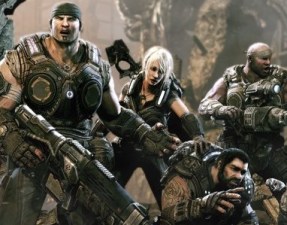 The Gears Of War 3 beta has gone out to people who write about games and are marginally important, well known, or whose opinions are of some significance. In other words, I haven't played it.
Allowing minor setbacks such as reality and truth to get in the way of my journalistic integrity would set a terrible precedent. You come to this poorly conceived, largely directionless feature on a biweekly basis for information about games which have been covered in a million other outlets, and you're going to get it. What follows is my account of what I imagine the Gears Of War 3 beta is like.
The first major change comes at the title menu, which has a "3" near the familiar Gears Of War logo. This clever bit of design hints that the game you're about to play isn't your daddy's Gears Of War or Gears Of War 2.
Once you find yourself in a multiplayer match, you'll discover that the men are large and muscular. These are not the sort of marines you'd want to mess with in space.
The male characters have very deep voices. I would classify many of them as gruff and strong. They use expletives because, hey, this is war, silly. They are under tremendous pressure to shoot other guys, which is why they bellow things like "fuck yeah" and "get some, bitch". These curse words and their voices lend character to the game, which does a great job of immersing you and making you care about their plight.
There's also a woman. She has big muscles and sounds tough. This is interesting because in all other games women are shallow and weak.
When you run, your character goes into a sort of crouch. This has two major benefits. First, it keeps your head down and allows you to avoid incoming fire. Second, it keeps the animators from having to make a sprint animation for a nine foot tall beef pile, which would inevitably look like Andre The Giant with a wedgie.
Surprisingly, cover plays a very important role. You will stick to cover and aim around corners or over barricades. When an opponent leaves his cover, you should shoot him, preferably while remaining behind cover. The good thing about cover is that it protects you from getting shot. It also slows down the action, since it takes longer to kill someone behind cover than in the open. This slower pace makes Gears Of War 3 a thinking man's shooter.
As important as cover is, guns are just as vital. There are many times when you will find yourself shooting a guy. Thank goodness you have a gun for that.
Many of the guns are large, probably so they don't seem too light for the space marines who have all those huge muscles. These guns make blood fly out of guys, and when you shoot a guy enough, they make him fall down and sometimes explode. I'd say this is the single most important advancement in shooters in the last twenty years.
It's not all about the guns, however! There are also weapons you can use when you get very close to a guy. These make everyone scream - the dude doing the killing, the dude getting killed, dudes that are just nearby and understandably freaked out by the whole thing. They make a lot of blood, so they're worth trying to do.
The environments are very interesting. The world is destroyed, but you can tell that it was once beautiful. It's almost as if the beauty was destroyed. This is a very powerful concept. As you play, you find that the theme has a large impact on your game, almost as much as the story and deeply developed characters.